Showing posts with label Oregon. Show all posts

Wednesday, January 13, 2016

Small Town America

Small Town America
This past summer, I decided to pull up stakes in Portland and move closer to my chosen field in the wine industry. I found a very affordable house within a mile of historic downtown McMinnville. It wasn't just the commute that was pulling me away from Portland. Somehow the Hipster Disneyland of the U.S. had lost its appeal, or maybe I just wasn't cool enough. I was frustrated by the quagmire of traffic, compounded by the bad manners of cyclists, but also by a slow disintegration of the city's soul. Having moved to Portland in 2008, I'm sure I was part of this slide; regardless, it felt like a good time to move.

I also found it interesting that a friend moved back south to Athens, Georgia, and another acquaintance moved back east, outside of Burlington, VT.  Two years prior, a friend moved to Telluride, Colorado. There was also a move to London and Lausanne, Switzerland, but those are outliers in this discussion. It seems to me there's a trend to move to small town America. The children of Suburban America, who grew up in strip malls and sprawl, we yearned for a sense of place, an ease of public transportation and food that was made with intention. But once we got there, we we missed the affordability of a home with a porch and with neighbors and friends close by. Where we didn't have to wait 2 hours for Sunday brunch or snarled in traffic to get to your friends' houses that lived on the outside of the other side of town. We wanted both. The answer is in small town America.

After retuning from the holidays in the South, where I visited Charleston, Atlanta and Athens, I found  a kinship between the large cities and small towns of the South and the Pacific Northwest. An argument could certainly be made for small towns outside of those two regions, but I have no authority to speak to those.

McMinnville, Oregon, naturally enough, was named for McMinnville, Tennessee (population 13,620)Linfield College. I am lucky enough to live close by and enjoy the lovely campus, which hosts our wine industry's annual International Pinot Noir Celebration (IPNC).
Linfield College's IPNC
by William T. Newby after his hometown in the South. He also later donated the land for the local institution of learning, McMinnville College, which was later named

McMinnville, Tennessee: McMinnville, like many smaller American cities and towns, has gone through a revitalization of its downtown area. "Main Street McMinnville" serves as the city's non-profit revitalization organization funded by the National Trust for Historic Preservation and Tennessee's own Main Street Program.[10] (Wikipedia)

McMinnville, Oregon: In the days of strip malls and big box stores, there is a place within the heart of Oregon wine country where the 1800s meets the 21st Century. While in communities around Oregon historic downtowns are struggling, along East 3rd Street in McMinnville, the downtown isn’t just surviving, but flourishing. (Oregon.Com)


Community Plate's Lavender Latte
As I was driving to Athens, GA, from Atlanta, I was struck by the similarities of the drive from Portland to McMinnville. The miles of sprawl outside the city, the traffic signals becoming slightly farther apart until they disappear altogether. Then there's just farmland and forests and the feeling that life is slowing down and becoming somehow easier. Now Athens is a college town and McMinnville is more like a wine town, an infant Napa or Sonoma. But they both have great downtowns with good food, drinks, shopping and an ease of walkability. The brick architecture and the craftsman, bungalow style homes echo each other. I enjoy good craft beer, breakfast, coffee, cocktails, food in both places. Athens takes a point for best breakfast and McMinnville takes a point for best coffee and wine lists. The Pacific Northwest has outstanding breakfasts, but it just can't beat the South. No grits? No fluffy biscuit? No cigar. If we could just combine the power of The Community Plate's Lavender Latte in McMinnville and the allure of the biscuit and Bird's Nest of Big City Bread. 
BIRD’S NEST 4.00
FRIED EGG IN SLICE OF SOURDOUGH TOAST WITH FRESH HERBS & GRUYERE CHEESE 
Big City Bread's Bird's Nest


As I was looking for information on the McMinnville's, I came across this Parade Magazine contest for best Main Streets in America. The winner was in Tennessee, the runner up was McMinnville, Oregon. You can't make that up! Even Parade Magazine sees a correlation between small towns in the south and in the Pacific Northwest. Congratulations to winner Collierville, TN, located outside of Memphis and my new hometown Finalist, located 35 miles south of Portland. 

My next correlation comes from McMinnville's annual UFO festival. It's the second largest one, falling behind Roswell, NM. 
The festival began as a way to honor the famous 1950 Trent sighting in which two local citizens witnessed and photographed a UFO, said to be some of the most credible images of UFOs to date.

Here's the complete history of the UFO sighting, but basically a woman went out to feed the chickens and saw a flying saucer. She ran back to the house, yelling for her husband to get a camera. Now, we Southerners know about the stereotypical perception Yankees have about us with regards to aliens. Nothing supports this more than this absurdly hilarious Yahoo! questions comment:
Anyone notice the uneducated south are the only ones who see UFOs?
I was reading about yet another UFO sighting in the south. Us in the north LOVE these stories because it blatantly points out the education difference between the north and south. One guy was quoted as saying: "You hear about big bass or big buck in the area, but this is a different deal" That's HILARIOUS! All they know is huntin' an' fishin'. It's amazing how backwards and uneducated they are! Agree or disagree? 

I strongly urge you to go the link and see how and who agreed or disagreed. But my point has been made. I think I searched Google for "aliens South believe" and that link came up in the top 5. Folks out here in small town, rural Oregon are pretty darn into huntin' and fishin' and spotting them UFOs too. I can't wait for my first UFO days in McMinnville this summer! And I guess I'll fit right in.

Friday, December 4, 2015

Go Dawgs! Georgia fans in Oregon

We find each other everywhere! This note was found on my car in the Ikea parking lot during the 2015 Labor Day Weekend rush. Shortly after, I was immersed in the intense and frenetic world of the grape harvest in Dundee, Oregon. I was unable to listen to or watch the Georgia Football games. I was there in spirit and would check my Yahoo Sports app on a regular basis for updates. I was quite sad to hear about Nick Chub's injury and to see the Dawgs drop out of the top 25. Also sad about the fallout with Mark Richt. I thought he was a great coach.

I also received a random email about my blog post in watching Georgia football at the Brooklyn Park pub, but I was so busy that I don't think I ever responded. I'm glad that the word got out though! Go Dawgs!

Sunday, August 3, 2014

Life's a...Coast?

Native Southern Idea of Beach
Recently I've come across quite a few quizzes on Facebook and such about "Which Beach Town Should You Move To?" These quizzes are a bit silly, but they also reveal something about our nation's preconceptions, simplifications and regional predilections. I, who live on the West Coast, took the quiz and my results said I should live in Wrightsville Beach, NC. My mom, who lives in Coastal South Carolina, and has always said that the beach was on the wrong side on the West Coast, got Carpentaria, California. I highly encourage you to Which Coast town should you live in? yourself and see if you agree with your results. 

I've just gotten back from a weekend camping at Beverly Beach State Park, and I'm also watching all the updates from my Southern friends playing at their respective beaches. Virtues about but they're mutually exclusive.

As a Southerner, I have to talk about this Beach vs. Coast terminology. And not just that, but the behavior that goes along with those terms. They are not exchangeable. The Pacific Northwest and the Southeastern interchange between land and ocean are so dramatically, drastically different. We cannot apply the same mores to each one. Indeed, we need to acknowledge them for the delightful and attractive attributes each can lay claim to. PNW it's the coast; SE it's the beach. 

Water Temperature

The Pacific is cold. One only gets in the water when one has on a wet suit. Little children, oblivious
Yeah, that's cold. It's August. 
to irrationally cold temperatures will delight in the tide pools. Their sweet mamas and papas will wrap them up in a warm blanket before too long. 

In the summer months, the Atlantic is bathtub warm. It's so darn hot, that that bathtub temperature alleviates the hotness of the air. It's wet, and one can dive beneath the surface or splash oneself on a float whilst drinking a cool libation. In a coozie. In fact, staying in the water from shortly after breakfast all the way until sundown is more or less the sign of a well tempered day. There may be a break for lunch, but not necessarily. 

Inland Ambient Coastal Temperature

My family lives on a tidal river in South Carolina. It's hot in the summer, and one can go down to the dock and just lay in a raft in the river all day. But when we really want to cool off, we take a trip to the beach. We plan week long stays at the beach. Growing up in Atlanta, going to school in Winston-Salem and Athens, living in Charlotte—what did we do in the summer when it was hot? Go to the beach. Where it was only slightly cooler. The first beach houses I remember staying at on Edisto Beach did not have air conditioning. We packed big window box fans in the car and put them in the windows at night. I can still remember the sound of rustling palm tree branches and the whirr of the fan. Somniferous. We were sunburnt and kicked the top sheet off, exhausted from the day's exertions we slept. 

Honestly, this is the hardest thing I've ever had to wrap my head around. It's just so contradictory for me. I drove from Carlton, Oregon, (in the confines of the Willamette Valley) to Lincoln City—about an hour and half a way. The temperature dropped by 40 degrees. No kidding. I was cold. I had to put on long pants and ... no, I had to put on almost all the clothing I packed with me. It was 55 degrees and I bought two bundles of firewood. I went out on the beach to watch the sunset, and I had to leave fairly quickly as the golden orb approached the horizon. I've worn the same manner of clothing in February at the beach as in August. Does not compute in my Southern brain. This is a COAST not a BEACH.

Coastal versus Beach Activities

That's some beauty (with sweaters in August)
Maybe it's my Southern superiority coming over me. I don't know. I want an Oregonian to explain this to me. Why, when it's 63 degrees and party cloudy, pretty much misty, are children, teenagers, grown adults wearing bikinis and bathing suits, playing frisbee, in general gallivanting as if it's warm and they're not uncomfortable? You don't need sunscreen! There's a layer of coastal fog hanging over the coast that's impenetrable. Bathing suits should be banned from the Oregon Coast. They don't belong. You can't get a tan and you're not bathing. Period. 

Beach combing is an activity that I condone for both coasts. In the South we find fossilized bones, shark's teeth and lovely shells. In the Pacific Northwest, we find gorgeous stones, drift wood and sedimentary fossils washed down from the cliffs. 

PNW has the unsurpassed awe inspiring beauty of the Pacific Ocean. The ability to build and enjoy a fire in humidity-free peace also endears me to the left coast. However, I will continue to have my feathers ruffled when folks out here say they're going to the beach. No. You're going to the coast. (Northerners can have their own opinions of The Shore—whatever that means). Maybe I'm just feeling a little homesick. I'd sure like to be sitting in a lounge chair, smelling of sunscreen, drinking a coldie and reading a good book. At any moment I'll rise up, stride to the surf, lounge back in the salt water and feel buoyed up by the salty embrace of the Atlantic Ocean. 
That's a salty, loving embrace at Edisto Beach, SC. My Grandparents are awesome! 

Thursday, June 12, 2014

Southern AND Sustainable?!

I first heard of Dan Barber's book The Third Plate on NPR the other day. The fact that Southern food was singled out as the only truly sustainable American way of farming and eating was exciting. No, not the Foodtopia and epicenter of sustainable everything in the Pacific Northwest. Yes, The South. I have yet to see Hoppin' John on a menu west of the Mississippi.

In the American South, it was beans, collards and some ham. "In a dish, you had everything that supported that ecology," he says.
A view of Dan Barber's Stone Barns Center field and barns in Pocantico Hills, N.Y.i
A view of Dan Barber's Stone Barns Center field and barns in Pocantico Hills, N.Y.
Nicole Franzen/Courtesy of Blue Hill Farm
But American tradition has fallen out of touch with the land. "There's no cuisine you can point to that has a 12-ounce center cut protein for dinner. ... That is an American phenomenon," Barber says


From an article in The Atlantic, I read Dan Barber's explanation of how farm-to-table practices in America aren't enough to be truly sustainable. The only place within the United States that has actually had a cuisine that fit the ecology of place was in the South.
That meat-centric plate is a great disservice to our soil, and to our ecology. It’s also a disservice to the rest of the world—because we’re exporting that model in a way that, in the truest sense of the word, is unsustainable. But we can find an alternative—what I came to call the Third Plate.
You find that in Southern cuisine, too. Hoppin’ John—a quintessential southern dish—is rice, but it’s also cowpeas. That leguminous crop was so important in the south, because it allowed the southerners to preserve their soil well enough to get them rice. Then, they mixed in collard greens, because collards helped desalinate the soil. (And some bacon, because pigs were also part of the agriculture.)

Last weekend I read a review of the book in the WSJ in Eugenia Bone's article "The Future of American Eating." Of course, it being a newspaper based in New York (damn Yankees), it doesn't mention this Southern connection. But what he does mention relates to my life in wine country. In the first of four sections in the book, "Soil"
Explores how some farming practices deplete the soil of nutrients by killing microbes and how others build healthy soil by feeding microbes. He compares industrial versus organic approaches to weed control and explains the role of grazing animals in soil health. 'How soil is managed,' writes Mr. Barber, 'and how a farmer negotiates weeds and pests, is the single best predictor of how food will taste.'

I've recently started a new job at Omero Cellar's in Carlton, Oregon, and I interviewed our new winemaker, Mr. Chad Stock about his winemaking philosophy in order to write a press release. What he said deeply related to what Mr. Barber is saying.

Stock explains that transparent winemaking, “allows wines to speak for themselves in a pure and true fashion. Pinot noir is all about nuance and it’s extremely adept at showing the subtleties of place.  Personal style preferences and winemaking additives blur the natural expression of the vineyard.“
Organic, and more importantly, biodynamic principles are important to Stock and the trajectory of Omero wines. He clarifies the joint importance of farming organically and implementing biodynamic principles in the vineyard and winery: “A vineyard is above and below the earth, so we want to farm the soil. We seek to show the significance in soil types and express the soil differences in the Willamette Valley. I’ll show you what your vineyard tastes like.”
By working without additives, using organic and biodynamic principles, Stock and Omero seek to create wines with distinctive character, authenticity and aromatic complexity.
While I am relatively new to the biodynamic farming and winemaking philosophy, I'm really eager to learn more. Like the John Muir quote that originally inspired Barber,  I find that everything is connected, from ideas to dirt:

When we try to pick out anything by itself, we find it hitched to everything else in the universe.

Wednesday, January 22, 2014

How do you stand the rainy winter months?

Gorgeous Oregon, but kind of Mordor
It's not the rain it's the darkness. That's what I always tell folks who ask me about the hardest part of Oregon's winter. Even if we had a full day of sunshine, the shortest day of the year in Portland, Oregon, is a almost an hour and a quarter shorter than Charleston, South Carolina.

Having just returned from a week in the Lowcountry, I'm more cognizant of this than ever. Having an entire week of longer days at the darkest time of the year is one of the best parts of traveling east for the holidays.

I recently read an article from Garden and Gun magazine about an artist— Fireworks: Betsy Eby's blowtorched canvases evoke the rhythm and flow of nature. As I'm always looking for connections between The South and The Pacific Northwest, I was delighted to read that Eby hails from Oregon and now lives in Columbus, Georgia. She's quoted in the article as saying, "The difference in the light is so extreme from the Pacific Northwest…It's so abundant and warm here. There's more information in the light…Being in the South allows me to split those hairs of color."

I can't say that I wholly agree with her assessment about there being more information in the light, but I can agree to the extremes in differences. Both entice me to wonder at the nuances of nature and revel in the joys of color and form of the great outdoors.

Lowcountry winter light
Oregon in winter time is muted, brooding and mysterious. Some days it can feel as if time stands still. There's no apparent difference between eleven AM and four PM. It's easy to forget oneself in the muffled, indistinct light. Because the day only lasts about 8 hours in the winter, this light is precious and indoor lighting, colors and spaces perhaps have more detail and attention paid than in The South.


The scarcity of light and the vicissitudes of the sky make me more attuned to the light in Oregon. I love watching the weather patterns shift atop one of the highest hills in Oregon wine country, just outside Dundee. Recently in the winter months, I've emerged from a sea of fog and cloud to see a dazzling blue bird sky. I can later watch little tufts of cloud skirting across the tree line and hovering over the vineyards. The tasting room can be totally shrouded in a thin layer of cloud, only to have the blazing bright sun illuminate it from behind. It's as if an alien spaceship has set its sights on us. It feels as if we're about to be beamed into a wormhole to another dimension. I've never seen light like that.

I think I can appreciate the light in The South so much more now after living in the Pacific Northwest. Perhaps that's what Eby is trying to say. But she's a native Oregonian living in Georgia, and I grew up in Georgia and am living in Oregon.  It's not the rain; it's the light.


Thursday, August 1, 2013

Southern Appreciation

There are some wry moments only a Southerner can truly appreciate. Take, for instance, my recent job interview at a small winery and vineyard a little north of Salem, Oregon.

Following an interstate, a traffic-light-ridden highway, country roads, and a very bumpy gravel road, I made my way to Amity Vineyards. I spoke with the owner for a while about my experience and wine sales approach. She mentioned in passing that one of the winery/tasting room employees was from Georgia.

When we went back inside, I told said employee, Anna, that I grew up in Georgia too. She asked, where? I responded, Marietta. She asked, which high school? I said Walton. She said, me too! I asked which neighborhood she lived in? Turns out we lived off the same traffic-light-ridden highway in Marietta, Georgia. Of course, she graduated over a decade after I did and probably never had the chance to see country, gravel roads in Marietta the way I had. These little moments in life are exquisite, but that's not the moment I'm referring to when I speak of Southerners appreciating life's wry sense of humor.

Take a close look at the menu. 
No, I asked another employee, Andrea, if there were any especially good spots in Amity for some lunch. She suggested Uncle Jack's BBQ. I usually avoid BBQ out west, but I was going to take her up on this one. From the outside, it was exactly what I was looking for.

The inside was too. A few tables were populated with locals as I made my way to the counter to inspect the menu. As I was gazing over the fare, I was thrilled to bits to see the prices. We're not in Portland anymore, Dorthy! The waitress asked if I wanted it to go, and I said no, and she said, oh well have a seat and I'll bring you some water and a menu. Such hospitality.

So I sat and observed the other side of the menu. I'll be dammed. Sweet tea in Oregon. I think this was the first time that I've actually seen it listed. Of course it's not listed in the South. That's a given. There is nothing better to wash down a pulled pork sandwich than some sweet tea. As my eyes scanned further down I was overjoyed to see the beer and wine selection. There were the usual suspects, yes. Bud, Coors, etc. But a Deschutes Seasonal? And bless my stars, a wine list!?! At BBQ?! I'm throwing down the gauntlet to my southern people. If you can find a BBQ joint (where you can get a sandwich and SALAD—cole slaw will count for $5.95) and they also offer a Pinot Noir and Gewürztraminer by the glass, I will send you one of my Domaine Serene Evenstad Reserve Pinot Noir from 2008. Seriously.

The BBQ was good. Unsurprisingly, the salad was a bagged version of iceberg, dehydrated carrots and purple cabbage, but I did get an option of balsamic vinegar dressing. While the sauce lacked a vinegar component that I so enjoy in a delectable BBQ sandwich, I was easily able to compensate by pouring my salad dressing directly on top. Gourmet. I mean gour—met.

Just as I was shaking my head in disbelief Anna from the winery came in to pick up some sandwiches to take back to the tasting room. Just two gals from Marietta, Georgia, eating some BBQ and talking wine in Amity, Oregon. America, to thee I sing!
The menu at Uncle Jack's. See previous photo for drink list


Monday, September 24, 2012

Fall, Equinox and College Football

If you think Packers, you don't know what I"m talking about.
It's that time of year again. Fall. Autumn. The Equinox. Here in the Pacific Northwest, the seasons change demonstratively. On Midsummer's Night, the sun rises before 5:30 AM and sets slightly after 9 PM. Just a few days ago, on the day of equal day and night, it rose at 7:00 AM and set at 7:00 PM. The angle of the sun changes, and the sun is already halfway to its southernmost arc. As a southerner, I find this transition particularly challenging. I find myself introspective, nostalgic and, at times, morose.


There's a certain slant of light, 
On winter afternoons, 
That oppresses, like the weight 
Of cathedral tunes.

There's a decay in the air and Indian summer days only serve to mock the dirges of dying bees, and the leaves on the trees are just—just—on the cusp. What can we do to shake ourselves from this melancholic reverie? College Football. And I'm not talking about it all, specifically, SEC and ACC. It's different out here, and I can't say that I altogether like it.

The University of Oregon dominates and they have this thing they call the "Civil War," when U of O plays Oregon State. The four years I've been here, the Ducks have beat the Beavers every time. UGA U. of Florida bar fights are more entertaining and vigorous than this rivalry.

If Oregon is on TV in a bar or pub, all 50 TV's must be tuned to that channel. But every cloud has its silver lining. Because the big, local bar refused to turn even one little monitor to the UGA game, we discovered our most beloved Portland gem, The Brooklyn Pub. There are 3 main TV's, and 3 more spread throughout this little space. The proprietor, Nate, is ready for we east coasters who watch early morning games.

Initially, we had to call and ask if he would turn on the UGA game. He was always accommodating. Sometimes we'd find ourselves in another part of town, unable to get a monitor changed because the Oregon game was on, and we'd call down.

Brooklyn Park Pub: How can we help you?
Me: Um, would it be possible to turn a TV to the UGA game?
BPP: We're so sick and tired of you Georgia people calling to ask, Dammit.
Me: Oh, geez, sorry...
BPP: Where ya been? It's already on...

Ah Southern hospitality can be found in the least likely of places. A northwest bar named after a yankee borough. I ask you!

We watch out games with Michigan and Penn State fans who have also found the Brooklyn. Nate makes us individualized breakfast plans and we refill our own coffee. Bloody Mary's frequently appear. Sometimes my friends and I are the only ones in the bar, and during half time Nate regales us with rants about how women used to rule the universe but then demanded "equality" and lost it all. History lessons often involve "taking it to the map."

All in all, I've enjoyed the different way I watch my college football. Of course, there's no more tailgating, and as the season wears on, I grow increasingly jealous of the beautiful southeastern skies broadcasted on the TV's. The slate gray skies and blanket of wet cloud envelops Portland, and we can only look on in envy as we see sunlight streaming through the Athens hedges. I can't even mention those Chick-fil-A commercials. Absolute torture.

My UGA sticker has faded such that people out here think I'm a Packer fan. Nobody recognizes the Wake Forest Seal on my car. Still, entering a bar at 9:00 AM here, looking around at other stool perchers: our eyes meet, we nod, and we know without saying a word. Go Dawgs! Go Deacs!

Tuesday, July 24, 2012

Road Trip: Ode to Summer Part II

Before I moved out west, summer used to mean international travel. Now that I am in Oregon, it means ROAD TRIP! That's not to say that I didn't dabble in some southeast road trips back in Georgia, North Carolina, and South Carolina; it's just that it might be comparing apples and oranges. Northwest is epic, grand, saga, awesome; Southeast is an intriguing short story, quaint, rock-n-roll rift, mysterious.

I recently read the article "Southern Roads: The Art of the Road Trip" from Garden and Gun magazine just before embarking on a trip from Portland, Oregon, to Montpelier, Idaho—some 800 miles of dynamic landscapes. While I knew the discrepancies in the two trips would be vast, Daniel Wallace did provide me with some pearls of wisdom that could be applied.
Southeast: You could discover a road like this.
1. Road trips are not vacations.
2. Get Lost
3. Get off the highway
4. Play Games
5. Go along for the ride 
Southeast: Highway traffic
Southeast: Cityscapes 
This is some excellent advice, especially for southern roads, because there really is nothing pretty about I-85, I-75, or I-95. Coming from someone who has driven up and down the eastern seaboard, I know. You do get to see some city profiles, but you're also just as likely to get stuck in snarling traffic with nothing to look at except rude bumper stickers or get woozy from idling fumes. 
Southeast: Pump your gas here.
While the west's byways are preferable, highways like I-84 through the Columbia River Gorge and eastern Oregon are amazing. I-90 through South Dakota, Montana, and Idaho are also awe inspiring. I like to turn on U2's Joshua Tree, The Garden State Soundtrack, or Ryan Bingham's Mescalito in these spaces.

Columbia River Gorge—Wet Side
Columbia River Gorge—Dry Side
1. Our road trip to Montpelier was not a vacation. I offered to accompany my friend on a road trip so that she could visit a dying friend, and she wouldn't have to drive. Contrary to what you might think, it was a life-affirming journey, and the thrum of the motor, the vast and infinite landscape lent to a meditative mindset. We did stop at less-than stellar Motel 6 in Twin Falls, where upon arrival we learned the pool was closed because a kid was sick in it. It had been 100 degrees out there, but the AC was pumping and we weren't there for the decor.

2. We did get lost trying to find Los Pinos in Mountain Home, Idaho. But I think it was because we were cranky and ready for some eats. I'm going to go ahead and give a shout out to this little restaurant. It's worth getting off the highway a little bit and way better than anything fast food can dish up.  

3. We got off of I-84 three times. At the start of our trip we decided on OR 26 East through Mt. Hood, down toward Madras, Prineville, and Prairie City toward Ontario, OR. On this route we were able to see the Painted Hills, John Day Fossil Beds National Monument, Ochoco and Strawberry Mountains. 

Pickle's Place, Arco, Idaho


Serendipity Atomic Days
On the return trip we took ID 26 west through Atomic City, Arco, and Craters of the Moon National Monument. Atomic City was going to be the pinnacle city of the nuclear age, with a reactor destined to be located here. Alas, that didn't happen, and now it only has a population of about 25. Down the road is the Idaho National Laboratory, kind of creepy. We decided on Arco for lunch, and it was crazy busy in Pickle's Place. When we asked, the waitress resignedly informed us that it was Atomic Days Weekend. Boy weren't we lucky! Fifty-seven years ago, Arco was the first city EVER to be lit by nuclear energy. And we made it for the celebration weekend. How perfect is that? 

Columbia River Gorge from WA 14 
Sunset on I-84
The final off-highway action was WA 14, which is on the north side of the Columbia River Gorge. The views are so spectacular that I almost always am unable to take any photos. It's just too much, really. We also let the gas dip below a quarter tank, and we had to coast into the Dalles on fumes. We had .46 gallons left. That's the risk you take when you're on scenic byways. 

4. Play games we did. We started off the trip taking the temperature, time, and location of our vehicle. It ranged between 7:00 AM and 11:00 PM, 57 and 106 degrees. We ended up adding elevation as well. If I get really dorky, I'll put some statistics together for you. We also played the license plate game, finding 26 states. That's more than half! Finally, and I owe this one to Mr. Wallace, we played his simple Roadkill Game. Oh man, this cracked me up:
Count the dead possums, armadillos, deer, raccoons, birds, snakes, and frogs, whether they're smashed flat on the faded white lane-dividing line or unceremoniously shoved to the shoulder. The first to a hundred wins.
We only made it 27, but it's not Mississippi.

5. "The road she ends up taking is as much a surprise to her as it is to us." We took some great chances on our route; it was hilarious, tragic, contemplative and harrowing. What a ride. This post is dedicated to Michael Felcher and his marvelous life and stories.
The road to Montpelier, Idaho


Monday, July 16, 2012

Camping: Ode to Summer

One of my favorite things about summer in the PNW is the camping. I did not grow up camping, unless hanging out in my dad's Vietnam army tent in the back yard until after the fireflies went out counts. My dad grew up in Colorado and California, and he always told great stories about camping with friends. So I can only explain my lack of camping experience to either my mother's aversion or southern climate. Maybe a little of both.

Other than one experience in southwest Virginia and one in Tennessee, I've only ever camped in the PNW. I'd take the latter over the former at most opportunities. I'm sure if I had more opportunities in Appalachia, coming on fall, I would have found more favorable experiences. Even living in Charlotte and Atlanta, it would have taken hours long car trip to get to the cool, rhododendron shades of the Smokies.

Choose your gear wisely
Here in Portland, camping spots are abundant, close, and at the same time, remote. I have to admit, my first camping experience was a bit of a disaster. Not having found a job yet, Fred Meyer was my point of sale rather than REI or Columbia. Standing in the sporting goods aisle, I opted for a 2 man tent and a junior sleeping bag. I was the size of some kids, right? It had cool colors and was $20 cheaper than the most inexpensive adult version. I figured I was set. Fast forward to that evening, when my friend, who was sharing my tent, pumped up her Therm-a-rest, pulled out her headlamp, and unrolled her super snazzy sleeping bag. I was still unconcerned. Fast forward to a few hours later, pitch black, and drizzling. I got into my bag, felt all the unevenness of the ground below me and zipped up. It came up to my chest. The "two man tent" was really meant for two small children, and our head and feet bumped up against the walls. There was nothing to do but laugh, albeit I had a very cold, wet and miserable night. It was late August.

When nature calls at night, it's best to have a headlamp
After that induction into PNW camping, I invested in a good bag, a blow-up sleeping mat, and a headlamp. Those items are necessities in my mind, and I can wait to make any other big camping purchases.

Silence of a Rushing River
Just an hour or two outside of Portland, there are innumerable camping spots, and further afield brings such a variety of scenery, it's hard to choose. Just this weekend, we followed the Clackamas River up towards the southeast side of Mt. Hood and found a spot on Hideaway Lake. Previous excursions include the Salmon River near Welches, along Yachats River on the coast, McKenzie River in the Sisters Wilderness, Timothy Lake near Mt. Hood, and two small lakes in south central Washington. I have to admit, the rushing rivers are my favorite, as I find the quiet, stillness of lakes unnerving. I've even worn earplugs to muffle the sound of silence. I am in the minority of my group of friends, but I feel in a state of timelessness next to the constantly moving river. There's a Zen quality about it for me.

My friends and I car camp, which means we can bring all the luxuries of home to a little spot in the wilderness. Carefully packed coolers and choice victuals and libations are easily carried in. I haven't graduated to the "hiking in" version of camping just yet.

There can be mosquitoes, but nothing that a little bug spray can't fix. It's simply not comparable to being out in the woods in the south.

A confirmed pyromaniac, I love being the fire starter and fire tender. I grew up dispensing of Hurricane Hugo debris via endless fires in South Carolina, but these were usually built in the depths of winter to stay warm or in the swarm of summer to keep the bugs away. Spanish moss makes volumes of smoke without a lot of heat. Here, in summer, the forest dries out a bit, leaving huge logs for endless burns. The smoke lends itself to kabobs for dinner and toast for breakfast. It gets chilly at night, and so many problems need to be solved. The campfire is the only solution.

Friends with kayaks
If your camping crew can get out early enough on Friday, you can have almost 3 days of exploring the wilderness from camp site home base. I enjoy playing in mountain streams and admiring the smoothness of stones and driftwood. I like to get out and go for a nearby hike that would otherwise be too far away for a day trip. If my friends brought kayaks, that's always a bonus too.

My two favorite hours on a camping trip are those  that bookend the time spent inside the tent. At night, once the headlamps are shut off, leaning back and looking up at that infinite and star scattered sky humbles me every time. Without humidity and the lack of light pollution, the starry dome is truly awesome. If we could look up at that every night, we could free ourselves from the insipidity of our modern life. Occasionally we are blessed with a shooting star, and we can almost perceive the slow cadence of the turning earth. Almost. The sounds of the wild soon mesmerize and lull us, and we must turn to bed. But I look forward to waking, unzipping the flap, awakening the embers of last night's fire, and brewing a cup of coffee. Sometimes alone, usually with an earlier riser, this hour is one of my most cherished. Except for utilitarian purposes, we talk little, still lost in the stardust of our dreams and the melody of the wild.
You can't see this in your backyard.

Thursday, July 5, 2012

In Homage to the Float


Be it on the east coast or the west, named the Sandy or the Toogoodoo, the river on which I float is Lethe, and I am in the Land of the Lotus Eaters. On a raft or a tube, floating in endless summer, it feels to be always afternoon. Truly there is a timeless quality about floating on water with friends and family, attending to no purpose other than the pursuit of pleasure. I have the privilege to experience, intimately, two floating settings that couldn't be more different from one another. The common denominators are moving water, summery weather, cool libations (ensconced in koozies of course), floatation devices, and good people. This is a little homage to the Toogoodoo and Sandy float.

The Toogoodoo Float


Marsh transitioning to plough mud
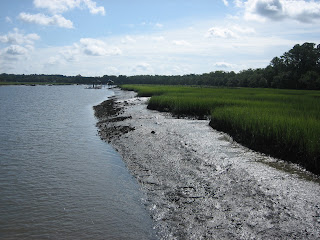
The Toogoodoo River flows east-west between my family's docks before it ultimately turns southward to the ocean. This is a tidal river, flowing east when the tide is coming in and west going out. Naturally, the water is briny and it brings with it all manners of salty creatures, from jelly fish to porpoise to blue crab to marsh grass. The banks are marshy at high tide and oyster crusted transitioning to plough mud at low tide. Sand bars appear as well, although it's a muddy sand, topped with mollusks. In my younger years, I used to wallow in the plough mud, that we could sink waist deep into, and it's probably the same stuff that appears in fancy spas. Now, I tend to pass it by and just enjoy the scant half-mile between four docks that belong to various members of my family.
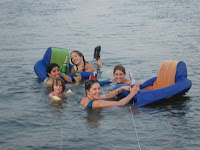
Tying floats to the dock
Because of the change in tides, the South Carolina float is best undertaken by swimming agains the tide to the destination, and then anticipating the languid float back, letting the tide do all the work. There's also always the option of tying your floatation devices up to the dock and the water becomes the change in scenery rather than the land. That option is not the focus of this post.
Facing north, Start at my parents' dock

I typically begin the float at my parent's dock, with my final destination being my Uncle Johnny and Aunt Loretta's dock not far to the west. I nominate said aunt as Queen of the Float, because she's always keen for being on the water. My most recent float was undertaken with a friend visiting from Raleigh and we met up with aunt, uncle, cousin Renee and her husband Billy. I also got to meet their dog, Red.
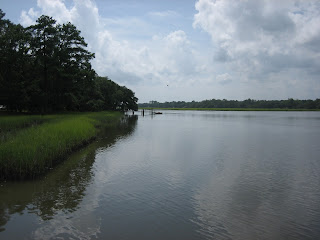
Original Butler dock on the Toogoodoo


Receding tide reveals mollusk encrusted bars


With unopened hops in our hand, we hopped in and began our triceps exercise westward, stroking against the tide. You can expect it to be hot and humid in the summer months (at least) in this low country spot, and the water's temperature is not appreciably lower than the air, but it's refreshing all the same. It's about the temperature of tepid bath water. It was hard work, but we made it to stop 1. My aunt and uncle host this dock now, but it was originally built by my grandfather many years ago. No one was home on this day, so I pushed to get there first, climb up and put in the ladder for my friend. This is a great ladder, metal, and supposedly taken from a swimming pool. It's barnacle encrusted and probably considered shabby chic now. This is the longest stretch without a breather, so we decided to refresh ourselves before pushing onward.

We don't have too long to go before we can pause at my Uncle Tommy's dock. He's banging nails, keeping the dock ship-shape. We inquire if he has any refreshments for us, but, alas, he's too busy being productive. He claims that "tomorrow" will be a relaxation day. About that time, a friend in a boat passes by and stops to visit with my uncle. Julie and I pause underneath the dock, hanging on to the pilings and enjoying a moment in the shade.  We don't have long to go until we meet up with Aunt Loretta and Renee.
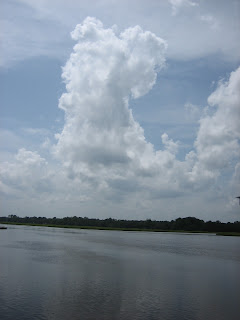
Those could be dangerous thunderheads later
We're in luck! Billy hands Julie and me a Corona, and we tie on to the floats. The tide is still flowing inward, but it's slowing now, and it's almost that perfect time when time and tide seem to stand still. The water turns to glass, reflecting the color and texture of the sky. We're not there just yet.

We exchange news, as it's been some time since I've seen my family. I've been at the beach for a week, and have some tales to tell from that. My cousin is returning to school to be a nurse, and Julie is a year-round elementary school teacher. We all remark on the challenges of school, and the changing nature of students with the advent of technology.

Soon it's time to untie the knots that bind, and Julie and I let go to the leisurely return float. In this time we are on a river of unmindfulness and we seem to experience complete forgetfulness, untouched by sorrow or cares of the world. A crane flies overhead and cicadas call from the live oak trees. Our rafts going with the current, "borne back ceaselessly into the past."
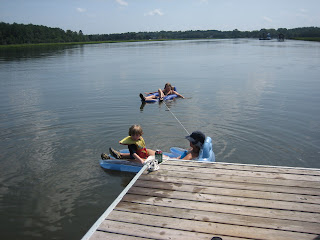
Unmoving Tide
Once we arrive back to our starting place, we tie up and enjoy the stillness of an unmoving tide. The river becomes a swimming pool, and we can almost imagine we lie on a mirror with a barely discernible dividing line of the horizon between water and sky.
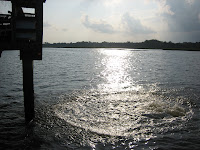
Cannonball!

Post Float Celebrations
At the end of the float, we can play, jumping off the dock and practicing our cannon balls. This is a time to pull up the crab traps, make a Beaufort Boil, enjoy some brewskis and anticipate yet another spectacular sunset. Life is good on the Toogoodoo.

The Sandy Float

Oregon's sunshine is amnesiac. One day of that endless blue, humid-free sky and weeks, nay months, of steely drizzle evaporate. Oregon bestows a month or two of these days each year, and some days the temperature can get into the 90s and 100s. For a southerner, these days are unreal—paradise. Colors are sharper, deeper, Kodachrome, kaleidoscopic. The sun's rays are warm and shadows provide relief. There's only one thing to do on these days: float the Sandy.
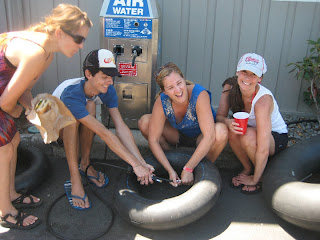
Jamie shows us how to properly inflate a tube.
After taking a look at the forecast, we plan for a Sandy float day. Pack the cooler with libations and snacks, brush the cobwebs from the black inner tube, and get your crew and two cars out to Troutdale. First stop is the Chevron, where we get some air in those tires! Make sure you bring your quarters, and get the person with the best technique to fill those babies as efficiently as possible. Stock up on any necessary goodies. Personally, I'm shocked that gas stations don't sell koozies in Oregon, much less ones with offensive quotes like "Helping ugly people have sex since 1862." One point for the south! In addition to the Chic-Fil-A foodcart, this should be my new entrepreneurial venture . . . 
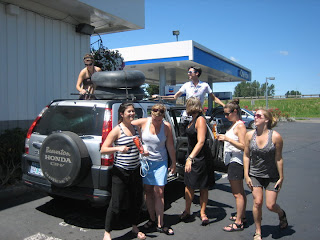
Sara is the master at securing the tubes.
Another important role is securing the tubes. We learned the hard way on our first float, when we belatedly realized that inflated tubes take up much more space than they did in the box and must be transported some how. Now we're prepared. Securing the tubes is an art form in and of itself, so make sure there's a person who has logistical sense in charge of that task.

Before we can reach the joy of oblivion, we must be pragmatic for one last task: parking and leaving the return trip vehicle. We leave this car near Lewis and Clark State Park, where we will ultimately exit the river. This is a task I do not relish. I never know what to leave or what to bring. I do know that having dry clothes and towel is instrumental to leave. Other than that, I can't be bothered to worry.

On hot days, many people have the idea to hit the Sandy. Parking is limited. They will give you tickets. I've gotten one, but I wrote a letter and they ultimately returned the money. I'm glad my mom instilled that value in me. The act of parking and leaving this vehicle is an anchor that keeps us from abandoning our lives and simply continuing to float onward toward the Columbia and out into the ocean. This is the act that grounds us in reality; it's what ties us to the mast. The siren's call of the float, the addictive quality of the amber light is strong, but we must get out. We must return.
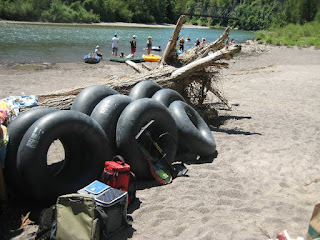
Tubes await
On that bittersweet note, we beat onward toward Dabney Recreational Area, where we lug in our tubes and gear. It  can be a long walk, especially if we want to move further south to have a longer float. Here is where we warm ourselves in the just afternoon sun, right when it has crested the eastern canyon walls, shining on the sandy, eastern side of the banks. The anticipation of timelessness thickens.

It's time to crack open a coldie and salute all the current voyagers as they languidly pass us by. There are all kinds of folks on the Sandy. There are reunions, softball teams, birthday parties, and even baptisms. The draw to the water is universal, I'll warrant.

A baptism on the Sandy
Once we've satiated our basic needs, it's time to secure the beer cooler to its tube and somebody has to volunteer to be on cooler duty. This is an important task, and not one to be undertaken lightly. Precious cargo, precious cargo. For the most part, all tubers are connected, but we don't want to be so attached that we can't separate in the face of treacherous rapids or downed trees. It's a buddy system, really.
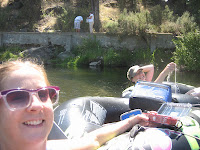
Beer Tube and water box
Ahh, that first dip, that easing into the tube. The black rubber is hot, and the Sandy water is glacier cold. It's ice melt after all; the contrast is delightful. We shove off, and we're away.

The start of the Sandy float begins at the base of huge horseshoe, so there's a constant sense of curving through the current, and the sunlight streams through Douglas Fir down to the canyon of light and shadow. We revolve in our tubes lazy-susan-style, and we begin to meander in a "mazy motion."

Our course is leisurely and we stop from time to time at sandbars to readjust or just sit in the sun after a shadow spell. We want to prolong the float. You can make friends or enemies with your fellow travelers. Usually it's friends, but we did get cranky with one crew that left all kinds of trash and cans on the sandbar. We just couldn't understand the seeming blatant discrepancy between enjoying the natural beauty and polluting it. "Give a hoot, don't pollute!"

There are 3 bridges that cross the Sandy over the course of our 3 mile voyage. Because of the curving and lazy current, I often get the impression that we are never reaching them or we're never leaving them. This contributes to the feeling of timelessness, as if we're moving, but not moving.

Underneath the E. Historic Columbia HWY Bridge
There are a few spots that add drama and danger to our float. A few times where there's a boulder dead ahead, and either you clutch to your buddy or relinquish them to fend for themselves. The current picks up, and it's "butts up! and "Wheeeeeee!" It's more fun to give voice to the exhilaration, like on a roller coaster. Then there's the tree that has fallen over a section of the Sandy that has been divided by a sand bar. For the intrepid tuber, she will take the dangerous route. For the practical tuber, she will simply pick her tube up and walk past the danger. Usually we tell the story about somebody who knows somebody who knows somebody who drowned on the Chattahoochee; or the story about how it was maybe in The Oregonian that somebody drowned in this exact spot last year.

All too soon we're nearing Lewis and Clark State Park, and I'm naturally inclined to wonder what it was like for those undaunted explorers. Then I comment to nobody, "We're just like Lewis and Clark." The Sandy float is a bit more adventurous than the Toogoodoo float, but that's really just the nature of the West. It's the frontier, and we're the trail blazers.
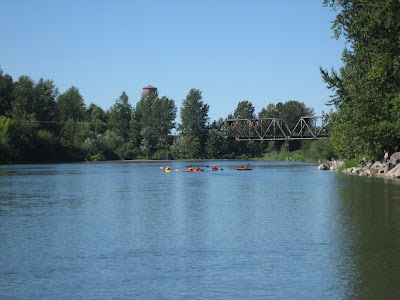
Towards the end of the float, near the RR bridge

It's going to be 88 degrees on Sunday. Got your tube?